
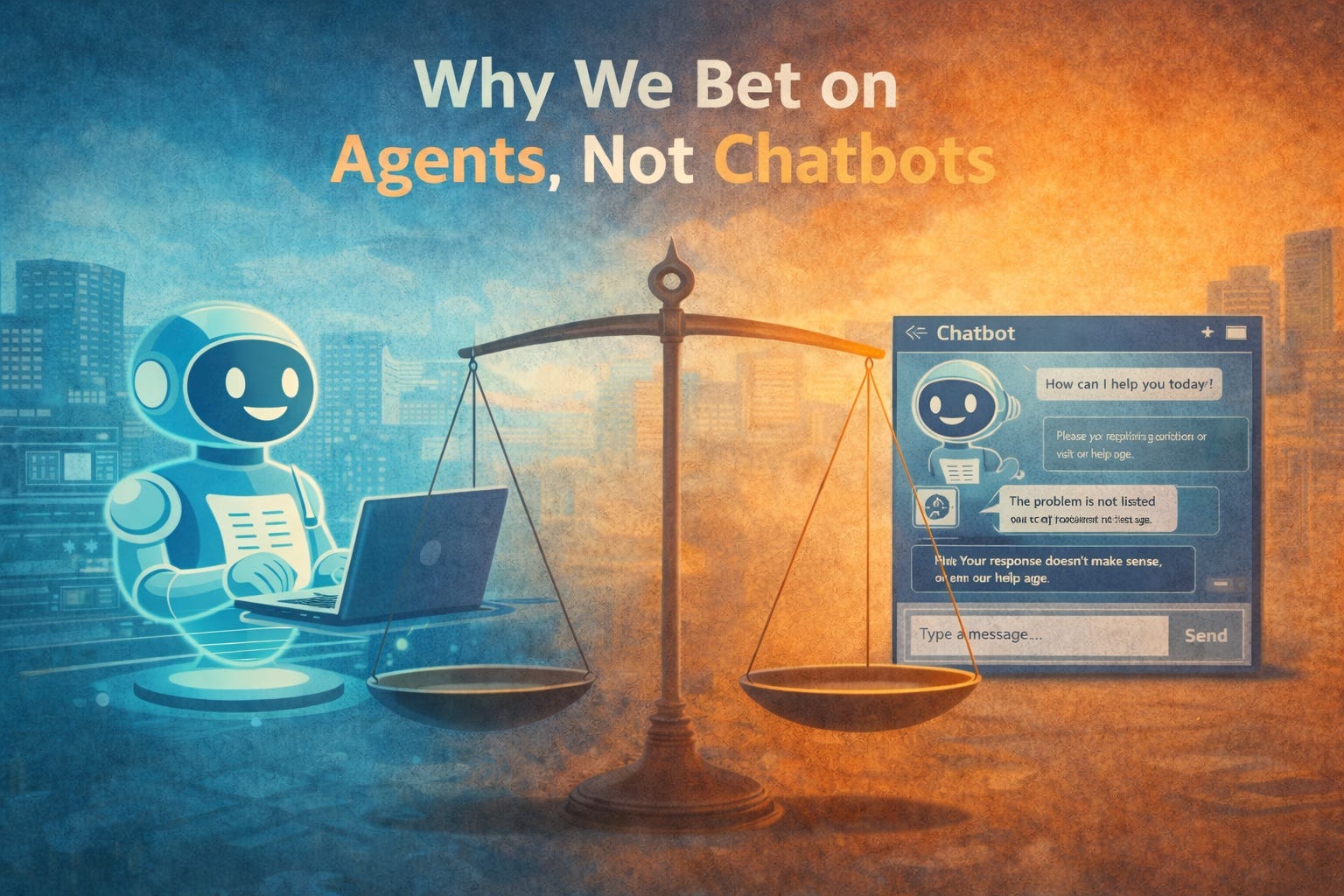
Everyone’s building chatbots.
Open a website. Bottom right corner. Little icon. Click it. A box appears. A cursor blinks. And then... you’re supposed to figure out what to do.
What do I type? What can this thing actually do? What’s it good at? What will it get wrong?
You’re standing in front of a blank text box, and the entire burden is on you to make it useful.
That’s the chatbot experience. And we think it’s fundamentally broken.
The Box Problem
Think about what a chatbot actually is.
It’s an empty box. A blinking cursor. A system that says: “Ask me anything.” Which really means: “Figure out the right question, phrase it correctly, and maybe I’ll give you something useful.”
That’s not how work works.
When you hire someone, you don’t hand them a blank piece of paper and say “ask me anything.” You give them a task. You say: “Reconcile these bank statements.” Or: “Analyse this data and tell me what’s going on.” Or: “Process these invoices and flag the ones that don’t match.”
The employee goes away, does the work, and comes back with a result. You review it. You approve it. Done.
A chatbot flips this entirely. Instead of the tool doing the work and reporting back, you have to do the work of figuring out how to use the tool. The cognitive load is on the human, not the machine.
That’s backwards.
How People Actually Think About Work
Here’s the thing the chatbot builders keep missing.
People don’t think in prompts. They think in outcomes.
Nobody wakes up and thinks: “I need to craft the perfect query for an AI system.” They think: “I need my bank reconciliation done.” They think: “I need to understand why revenue dropped last month.” They think: “I need these 200 transactions categorised before the auditor arrives on Friday.”
Work is specific. Work has context. Work has a starting point, a process, and an expected output.
A chatbot ignores all of that. It strips away the context and gives you a blank box. It’s like replacing your entire accounting team with a stranger who says “ask me anything about numbers” but has never seen your books.
Agents are different. Agents start with the work.
What an Agent Actually Does
An agent doesn’t wait for you to figure out the right question. An agent already knows the job.
Take bank reconciliation. A business owner downloads their bank statement, a messy PDF, maybe a CSV, whatever the bank spits out. Thousands of transactions. Some match invoices. Some don’t. Some are duplicates. Some are fees they didn’t expect. Some are payments from customers who didn’t include a reference number.
A chatbot would say: “Upload your file and tell me what you want.”
An agent says: “I see 1,247 transactions. I’ve matched 1,180 to existing records. Here are 67 that need your attention, 23 look like duplicate charges, 31 are missing references, and 13 don’t match any invoice on file. Here’s my recommendation for each one.”
See the difference?
The chatbot made you think. The agent did the work and made you decide. Thinking and deciding are very different cognitive loads. One is exhausting. The other is efficient.
The Back-and-Forth That Matters
Here’s where agents really pull ahead.
Real work isn’t a single question and answer. Real work is iterative. It’s messy. It requires going back and forth until you get to the right answer.
A chatbot gives you one shot. You type a question. You get a response. If it’s wrong, you have to figure out why it’s wrong, rephrase your question, add more context, try again. You’re debugging the AI. That’s not work, that’s wrestling with a tool.
An agent handles the iteration for you.
By the time it reports to you, the heavy lifting is done. Your job is to review, not to prompt.
A chatbot makes you the operator. An agent makes you the reviewer.
And reviewers are far more productive than operators.
The Real Problem: Scaffolding
So if agents are obviously better, why isn’t everyone building them?
Because agents are hard.
A chatbot is relatively simple. Take a language model. Put a text box in front of it. Let users type stuff. The model responds. Ship it.
An agent requires scaffolding. And scaffolding is where it gets complicated.
Scaffolding means: How does the agent know what to do? How does it break a task into steps? How does it decide what to do when something goes wrong? How does it know when to ask for help versus when to push forward? How does it maintain context across a complex, multi-step process? How does it know your business, your chart of accounts, your vendor names, your preferences?
This is the hard part. The language model is the engine, but the scaffolding is the entire car, the steering, the brakes, the navigation, the chassis. Without scaffolding, you just have a powerful engine sitting on the floor. Impressive, but useless.
Building good scaffolding means understanding the work deeply. Not AI in the abstract, the actual work. The specific steps of bank reconciliation. The logic of transaction matching. The rules of double-entry accounting. The quirks of how different banks format their statements. The patterns of how real businesses categorise expenses.
You can’t scaffold what you don’t understand.
Why We’re Building Tyms
This is exactly why we’re building Tyms.
We’re not building a chatbot that says “ask me about your Ops.” We’re building agents that do Ops work, work that has clear inputs, defined processes, and expected outputs.
The problem was never “businesses need someone to talk to about accounting.” The problem is: “Businesses drown in operational work that should be automated but can’t be, because until now the scaffolding didn’t exist.”
Chatbots tried to solve this by putting a smart language model behind a text box and hoping users would figure it out. That’s lazy. It shifts the burden to the user. It works for simple questions. It falls apart for real work.
We’re taking the harder path. Building the scaffolding. Understanding the work. Designing agents that know what the job is before you even open the app.
You don’t ask Tyms to reconcile your books. You give Tyms your bank statement and Tyms reconciles your books. That’s not a subtle difference. That’s a fundamentally different product.
Chatbots Are a Demo. Agents Are a Product.
Here’s the uncomfortable truth for the chatbot crowd.
A chatbot is a demo of what AI can do. An agent is a product that does what AI can do.
Demos impress. Products deliver.
A demo shows you what’s possible. A product makes it happen. A demo requires you to imagine the use case. A product is the use case.
The world doesn’t need more demos. Business owners don’t need to be impressed by AI. They need their reconciliation done. They need their reports generated. They need their invoices processed. They need the work handled.
That’s what agents do.
The Future Is Work-Shaped, Not Box-Shaped
We bet on agents because we bet on work.
Work has structure. It has context. It has steps, dependencies, and expected outcomes. It has domain knowledge and business rules and edge cases that matter.
A chatbot ignores all of that and gives you an empty box.
An agent embraces all of that and gives you a result.
The question was never “how do we get AI to talk to people?” The question is: “how do we get AI to work for people?”
That’s what we’re building at Tyms.
Agents that work. Not chatbots that chat.
We’re building Tyms for businesses that want work done, not conversations about work. If that’s you, check out what we’re building at tyms.ai
What’s your experience with chatbots vs. agents? Have you seen the difference? Reply and let me know, I read every response.